


Hypothyroidism vs. Hyperthyroidism: What the Difference May Mean for Your Symptoms

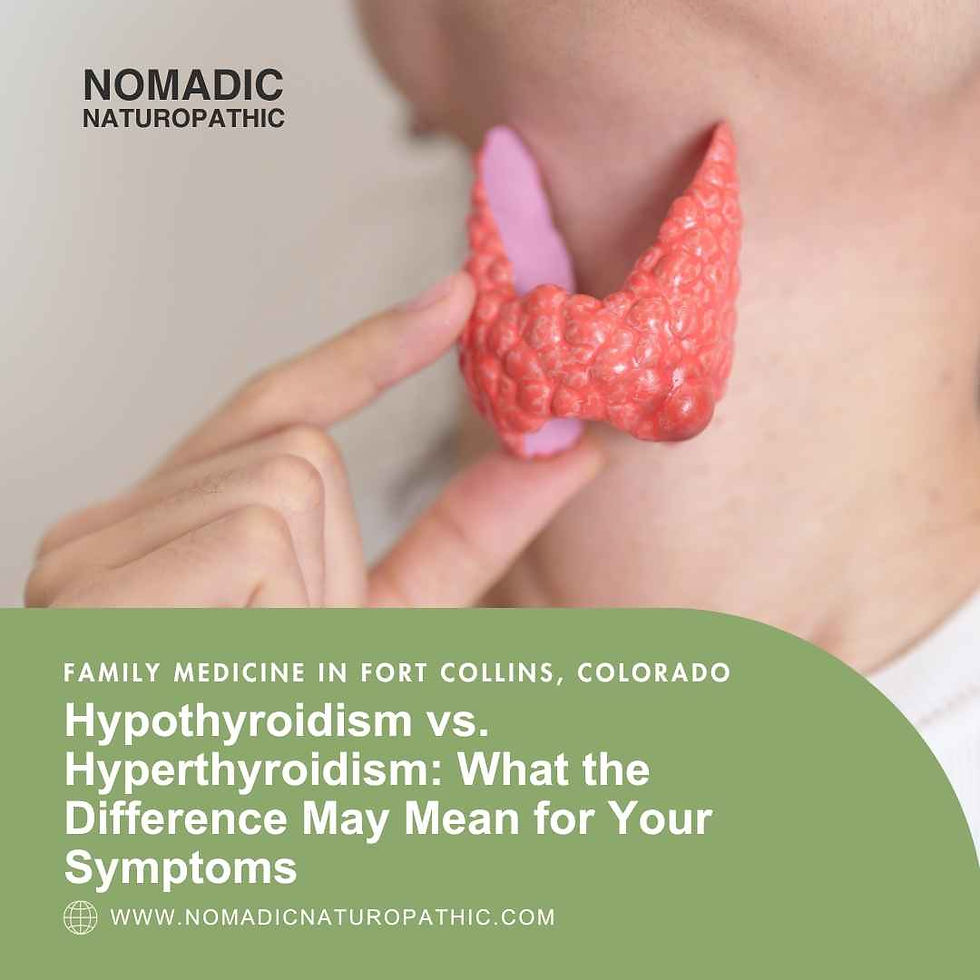
The thyroid can malfunction in two opposite directions, and the difference shapes everything: the symptoms you feel, the tests that matter, the urgency of evaluation, and the treatment conversation that follows. Hypothyroidism means too little thyroid hormone; hyperthyroidism means too much. Same gland, mirror-image problems.
This article answers one question: how do hypothyroidism and hyperthyroidism differ, and why does the distinction matter for you? It belongs to the thyroid series at Nomadic Naturopathic in Fort Collins, Colorado. The series hub, our root-cause guide to thyroid disorders, maps the whole territory, and companion pieces cover Hashimoto's thyroiditis and what a complete thyroid panel includes.
Two Directions, One Thermostat
Think of thyroid hormone as the body's metabolic thermostat setting. In hypothyroidism, the setting drops too low: cells burn energy more slowly, heat production falls, and systems downshift. In hyperthyroidism, the setting is stuck too high: metabolism races, heat builds, and systems run fast and ragged. Neither direction is subtle at full expression, but both can begin quietly, which is where confusion starts.
The underlying causes differ too. In the United States, most hypothyroidism traces to Hashimoto's thyroiditis, an autoimmune process that slowly reduces the gland's output. Most hyperthyroidism traces to Graves' disease, a different autoimmune condition in which antibodies stimulate the gland to overproduce. Thyroid nodules that autonomously make hormone, thyroid inflammation that leaks stored hormone, and medication effects account for much of the remainder in both directions.
Prevalence differs as well, and it shapes what gets recognized. Hypothyroidism is considerably more common, so both patients and providers tend to think of the thyroid mainly as something that runs slow. Hyperthyroidism, being rarer, is more often misattributed to anxiety, caffeine, or life stress, sometimes for months. Knowing that the gland can err in either direction is half the battle in getting the right question asked at the right time.
Symptoms That May Point to an Underactive Thyroid
Hypothyroid symptoms are the physiology of slowing down: persistent fatigue that sleep does not repair, feeling cold when others are comfortable, constipation, dry skin, coarse or thinning hair, puffiness in the face, gradual weight gain despite unchanged habits, heavy or irregular menstrual cycles, low mood, slowed thinking, and a general sense of moving through syrup.
Because these changes creep in over months, they are easy to attribute to age, stress, or a demanding stretch at work, a pattern we explore in Is It Your Thyroid? Symptoms That May Deserve a Closer Look. The quiet onset is precisely why family history and clusters of symptoms matter more than any single complaint.
Symptoms That May Point to an Overactive Thyroid
Hyperthyroid symptoms are the physiology of running hot: unintended weight loss despite a strong appetite, a racing or pounding heartbeat, palpitations, heat intolerance and sweating, a fine tremor in the hands, anxiety or irritability that feels chemical rather than situational, more frequent bowel movements, lighter or absent menstrual cycles, and sleep that will not come despite exhaustion.
Graves' disease sometimes adds eye changes, a gritty sensation, bulging, or double vision, that deserve specialist attention in their own right. Hyperthyroid symptoms are more likely than hypothyroid ones to be mistaken for anxiety disorders, particularly in younger women, and that misread can delay diagnosis while the heart carries the burden.
Possible Contributing Factors in Both Directions
Autoimmunity dominates both conditions, and the influences on immune behavior overlap: genetics and family history, major hormonal transitions such as the postpartum year, chronic stress and disrupted sleep, smoking (particularly linked to Graves' eye disease), prior infections, and gut health. Iodine sits in a special position, since both deficiency and excess may push thyroid function in unhelpful directions; one reason unsupervised iodine supplementation is generally not advisable.
The postpartum window deserves particular mention because postpartum thyroiditis can move through both directions in sequence, a hyperthyroid phase followed by a hypothyroid one, often mistaken for the ordinary exhaustion of new parenthood. New parents in Fort Collins juggling sleep deprivation and recovery should know that persistent symptoms beyond the expected fog may warrant simple lab testing.
How Testing Distinguishes the Two
Blood work separates the directions cleanly in most cases. In hypothyroidism, TSH rises as the pituitary asks for more hormone while free T4 falls; in hyperthyroidism, TSH is suppressed toward zero while free T4 and free T3 climb. Antibodies then clarify the cause: TPO antibodies point toward Hashimoto's, while TSH receptor antibodies point toward Graves'. Our guide to the full thyroid panel walks through each marker and the in-between patterns, such as subclinical disease, where numbers sit near the edges of range.
Hyperthyroid evaluations sometimes add imaging or uptake studies to distinguish an overproducing gland from one leaking stored hormone, a distinction that changes management considerably. This is a place where naturopathic and conventional care naturally work side by side.
A word about borderline results in both directions: subclinical hypothyroidism (mildly elevated TSH with normal free T4) and subclinical hyperthyroidism (suppressed TSH with normal hormone levels) are common findings, and neither automatically requires treatment. Both may warrant monitoring, a check of antibodies, and an honest weighing of symptoms, age, heart health, and bone health with your provider. Treating the person rather than the lab slip is the principle either way.
When to Seek an Evaluation
In either direction, seek an evaluation when several symptoms cluster and persist beyond a few weeks, when thyroid or autoimmune disease runs in your family, when the postpartum year feels harder than expected, or when previous borderline labs were never rechecked. Overactive-direction symptoms deserve a shorter runway: a persistently racing heart, unintended weight loss, or new tremor merits testing promptly rather than eventually.
Bring notes if you can: when each symptom began, how your weight, cycles, sleep, and heart rate have behaved, and any family history you know. A short timeline often tells the diagnostic story faster than any single lab value, in whichever direction your thyroid is leaning.
How Functional and Naturopathic Medicine May Help
A functional and naturopathic approach begins by confirming which direction, and which cause, you are actually dealing with, through complete testing and an unhurried history. From there, care is individualized: coordinating with prescribing providers where medication or specialist care is appropriate, particularly in hyperthyroidism; addressing documented nutrient gaps; supporting the stress physiology, sleep, and gut health that influence immune behavior; and setting a monitoring rhythm so changes are caught early rather than discovered late.
For people across Northern Colorado who want to understand the process before committing, our What to Expect page lays out how a first visit, testing, and follow-up unfold step by step.
When to Seek Prompt Medical Care
Hyperthyroid physiology creates most of the true urgencies. Seek emergency care for a very rapid or irregular heartbeat, chest pain, fainting, or fever with agitation and confusion, features that can accompany thyroid storm. On the underactive side, severe drowsiness, confusion, or unusually low body temperature in someone with known hypothyroidism, especially during illness or extreme cold, warrants emergency evaluation. New eye bulging with pain or vision change, a rapidly enlarging neck mass, or difficulty swallowing or breathing also deserve prompt attention, as does pregnancy alongside any known or suspected thyroid condition.
Frequently Asked Questions
Can you have both hypothyroidism and hyperthyroidism?
Not at the same moment, but you can experience both over time. Early Hashimoto's occasionally produces temporary hyperthyroid symptoms when inflamed thyroid tissue releases stored hormone, before settling into the underactive pattern. Postpartum thyroiditis classically moves through a hyperthyroid phase followed by a hypothyroid one. And treatment itself can swing the pendulum: an over-replaced hypothyroid patient can develop hyperthyroid symptoms from medication. This is why symptoms that change character deserve re-testing rather than assumption.
Which is more serious, an overactive or underactive thyroid?
Both deserve proper care, but untreated hyperthyroidism tends to carry more near-term risk, particularly for the heart, because sustained excess hormone can drive rapid or irregular rhythms and, rarely, escalate into thyroid storm. Untreated hypothyroidism generally progresses more slowly but erodes quality of life and carries its own long-term consequences. The practical takeaway is the same in either direction: clear diagnosis and appropriate management, rather than waiting it out.
Can stress cause hyperthyroid-like symptoms?
Stress physiology can convincingly mimic an overactive thyroid: racing heart, restlessness, sweating, sleep trouble, and weight changes can all follow sustained cortisol and adrenaline output. That overlap cuts both ways, since real hyperthyroidism is sometimes dismissed as anxiety, particularly in younger women. Testing is the only reliable way to tell the difference, which is why persistent symptoms in either direction may warrant labs rather than reassurance alone.
Where can I get evaluated for thyroid symptoms in Fort Collins?
Nomadic Naturopathic evaluates both underactive and overactive thyroid patterns in Fort Collins, Colorado, with comprehensive lab testing and a root-cause approach, coordinating with conventional providers when prescription treatment or urgent care is appropriate. A free 15-minute consultation is an easy first step to see whether the fit is right.
Medical Disclaimer
The information provided in this article is for educational purposes only and is not intended as medical advice, diagnosis, or treatment. Always consult a qualified healthcare professional before making changes to your healthcare routine or beginning any new treatment.


Comments