


Understanding Biofilms and Why Chronic Infections Can Be Difficult to Resolve

You get sick, receive treatment, and start feeling better.
Then the symptoms come back.
Or perhaps you have been dealing with recurring infections, persistent inflammation, sinus problems, urinary symptoms, chronic wounds, or another health concern that never seems to completely resolve.
When infections become persistent or recurrent, there are many possible explanations. One concept that sometimes enters the conversation is the biofilm.
Biofilms are real, well-established microbial structures that play an important role in certain chronic and difficult-to-treat infections. But they are also frequently misunderstood online. Having unexplained fatigue, digestive problems, or inflammation does not automatically mean you have a hidden biofilm.
At Nomadic Naturopathic, we don't guess. We investigate.
Understanding the science behind biofilms chronic infections can help you separate established medical evidence from oversimplified claims and understand why identifying the actual source of persistent symptoms matters.
What Is a Biofilm?
Bacteria do not always live as individual, free-floating organisms.
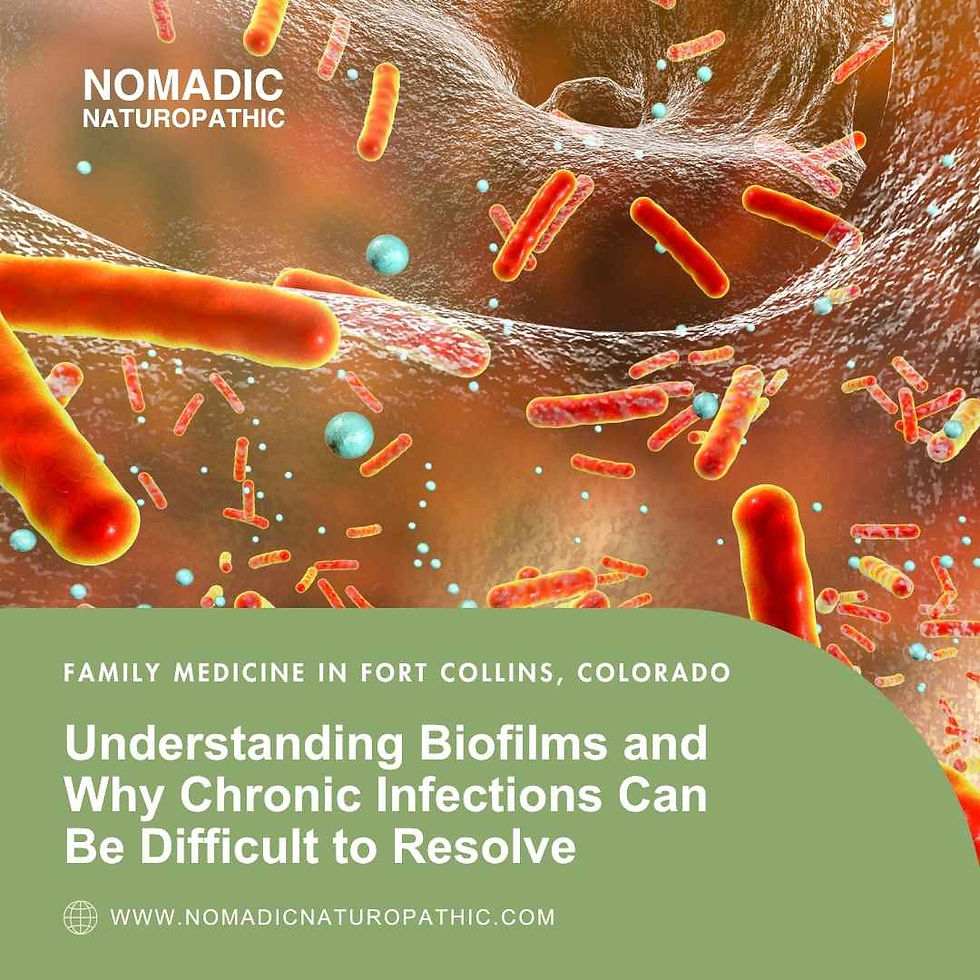
Under certain conditions, microorganisms can attach to a surface, organize into communities, and surround themselves with a self-produced matrix made from substances such as polysaccharides, proteins, extracellular DNA, and other materials.
This organized microbial community is called a biofilm.
Biofilms develop through several stages, including attachment, growth, maturation, and eventually dispersion, when microorganisms may leave the community and spread elsewhere. (PubMed Central (PMC))
A simple way to picture a biofilm is to imagine a microbial community building its own neighborhood.
Instead of individual bacteria existing independently, they live together within a structured environment that can help them adapt to changing conditions.
That structure can make certain infections significantly more difficult to eliminate.
Biofilms Are Not Automatically Harmful
The word "biofilm" can sound alarming, but biofilms are common in nature.
Microorganisms form biofilms on rocks, pipes, industrial equipment, and biological surfaces. Microbial communities can also exist as part of normal human ecosystems.
The clinical concern arises when disease-causing microorganisms form biofilms in places where they contribute to infection.
Well-established examples include biofilms associated with:
Urinary catheters
Prosthetic joints
Vascular catheters
Certain implanted medical devices
Chronic wounds
Some chronic respiratory infections
Certain dental infections
Biofilms are particularly important in device-associated infections because microorganisms can attach to artificial surfaces and become difficult to eradicate. (PubMed Central (PMC))
Why Can Biofilm-Associated Infections Be Difficult to Resolve?
One of the defining characteristics of biofilms is that microorganisms living within them can behave differently from free-floating microorganisms.
This can make them more tolerant of antimicrobial treatment and immune defenses. (PubMed Central (PMC))
Several mechanisms may be involved.
1. The Biofilm Creates a Protective Environment
The extracellular matrix surrounding a biofilm provides structure and protection.
This matrix can influence how antimicrobial substances move through the microbial community and can help create different chemical environments within different parts of the biofilm. (PubMed Central (PMC))
This does not mean the biofilm forms an impenetrable wall.
Some antibiotics can penetrate biofilms.
The bigger problem is that microorganisms living inside the biofilm may behave differently once the medication reaches them.
2. Some Microbes Inside Biofilms Grow Very Slowly
Many antibiotics work most effectively against actively growing bacteria.
Inside a mature biofilm, however, oxygen and nutrients may not be distributed evenly.
Some microorganisms remain active while others grow slowly or become metabolically inactive.
These slow-growing cells can be less susceptible to treatments that depend on active bacterial growth. (PubMed Central (PMC))
This physiological diversity is one reason a biofilm-associated infection can be more difficult to eliminate than an infection involving primarily free-floating bacteria.
3. Biofilms Can Contain Persister Cells
Researchers have also identified bacterial populations known as persister cells.
These cells are not necessarily genetically resistant to an antibiotic.
Instead, they temporarily enter physiological states that allow them to survive antimicrobial exposure.
Once the antimicrobial pressure disappears, surviving cells may become active again and contribute to recurrence. (PubMed Central (PMC))
This distinction is important because persistence, tolerance, and antibiotic resistance are related but different concepts.
Biofilm Tolerance Is Not the Same as Antibiotic Resistance
The terms are often used interchangeably online, but scientifically they mean different things.
Antibiotic resistance generally means bacteria have genetic characteristics that allow them to grow despite exposure to an antibiotic that would normally inhibit or kill them.
Antibiotic tolerance means bacteria may survive temporary antibiotic exposure without necessarily having a higher conventional resistance measurement.
Biofilms can create physiological conditions that increase tolerance even when the organisms do not have classic genetic antibiotic resistance. (PubMed Central (PMC))
Some biofilm communities may also facilitate the development or spread of true antimicrobial resistance, which makes the clinical picture even more complicated.
Why Chronic Infections Can Come Back
Imagine treating an infection and eliminating most of the actively growing bacteria.
You feel better.
But if a protected population remains within a biofilm, those microorganisms may later become active again.
This is one reason biofilm-related infections can sometimes follow a pattern of:
Symptoms → treatment → improvement → recurrence
Established medical literature recognizes biofilms as an important contributor to persistent and recurrent infections, particularly in certain tissue and medical-device settings. (PubMed Central (PMC))
But recurrence alone does not prove a biofilm is present.
Recurrent symptoms can also result from reinfection, anatomical problems, inadequate source control, immune factors, inappropriate antimicrobial selection, or entirely different conditions.
Can Your Immune System Eliminate Biofilms?
The immune system recognizes and responds to microbes within biofilms, but biofilm architecture can make complete clearance difficult in some settings.
The matrix, altered microbial metabolism, local inflammation, and other factors may reduce the effectiveness of normal immune responses. (PubMed Central (PMC))
This may contribute to a situation where inflammation persists around an infected site without completely eliminating the microbial community.
Again, this phenomenon is well documented in specific biofilm-related infections.
It should not be used as a blanket explanation for every case of unexplained inflammation.
Are Biofilms the Cause of Chronic Fatigue or Brain Fog?
Not automatically.
This is an area where online health information frequently moves beyond the evidence.
Fatigue, brain fog, digestive problems, joint discomfort, and other nonspecific symptoms have many potential causes.
Biofilms are medically important, but having these symptoms does not establish that someone has a hidden biofilm infection.
A responsible clinical approach begins by identifying whether there is evidence of an infection in the first place.
Then the question becomes whether biofilm formation is relevant to that specific infection and clinical setting.
How Are Biofilm-Associated Infections Diagnosed?
There is no universal blood test that simply tells you, "You have biofilms."
Evaluation depends heavily on where the suspected infection is located.
Depending on the situation, conventional evaluation may involve:
Medical history
Physical examination
Cultures
Imaging
Blood testing
Tissue or fluid sampling
Evaluation of implanted medical devices
Specialist consultation
Biofilm-associated infections can sometimes be difficult to diagnose because microorganisms within biofilms may not behave the same way as free-floating organisms that are easier to capture using standard cultures. (PubMed Central (PMC))
That does not mean negative conventional testing automatically proves a hidden biofilm exists.
Testing must always be interpreted within the entire clinical picture.
What Does Biofilm Treatment Actually Involve?
If you search online for biofilm treatment, you will find supplements, enzymes, herbs, "biofilm disruptors," detox protocols, and many other products.
This is where careful interpretation is essential.
For established biofilm-associated infections, conventional management depends on the location, organism, severity, and underlying source.
In some medical-device infections, eliminating the infection may require removal or replacement of the colonized device in addition to antimicrobial treatment. Chronic wounds may require appropriate wound care and debridement. Other infections require organism-specific treatment directed by the appropriate medical professional. (PubMed Central (PMC))
Researchers are studying many new approaches to disrupting biofilms, including therapies targeting the biofilm matrix, microbial communication, persister cells, and other mechanisms. Many of these remain areas of active investigation rather than established universal treatments. (PubMed Central (PMC))
So there is no single evidence-based "biofilm protocol" that applies to every patient.
Where Natural Medicine Fits
Dr. Danny Dowling is a Registered Naturopathic Doctor in Colorado. His role is not to replace medically necessary antimicrobial treatment or imply that herbs can eradicate every biofilm-associated infection.
Instead, a whole-person approach can begin by asking better questions.
Is there evidence of an infection?
Was the original infection adequately identified?
Is the same infection recurring, or could this be reinfection?
Are there structural or environmental factors contributing?
How are digestion, nutrition, sleep, stress, and immune function affecting overall resilience?
When appropriate within his scope, Dr. Dowling may use clinical nutrition, herbal medicine, lifestyle therapies, nutrient support, and targeted testing to address modifiable underlying drivers and support the patient's overall health.
When an infection requires conventional antimicrobial treatment, surgery, device removal, or specialist care, appropriate medical coordination is essential.
Why "Kill the Biofilm" Is Usually the Wrong Starting Point
A supplement-first approach starts with:
"What can I take to break down biofilms?"
A better clinical approach starts with:
"What evidence do we have that a biofilm-related infection is actually present?"
That difference matters.
If you treat an assumed biofilm without identifying the underlying problem, you may spend months chasing the wrong explanation.
Persistent symptoms could instead be related to:
A post-infectious condition
An inflammatory disorder
Digestive dysfunction
Hormonal changes
Nutrient deficiencies
Sleep problems
Another medical condition entirely
This is why investigation comes first.
A Root-Cause Approach to Biofilms and Chronic Infections
At Nomadic Naturopathic, we don't assume every difficult-to-resolve illness is caused by a hidden infection or biofilm.
We look at the entire story.
That may include:
When symptoms began
Previous infections
Treatment history
Whether symptoms completely resolved
Patterns of recurrence
Digestive health
Immune and inflammatory symptoms
Nutrition
Sleep
Environmental factors
Appropriate conventional or functional testing when indicated
The purpose of this investigation is not to collect as many tests as possible.
It is to identify meaningful patterns and determine what actually deserves attention.
When Persistent Infection Symptoms Need Further Evaluation
Seek appropriate medical evaluation if you experience recurring or persistent signs of infection, particularly symptoms such as:
Recurrent fever
Persistent localized pain or swelling
Wounds that are not healing
Recurrent urinary symptoms
Persistent respiratory symptoms
Drainage from a wound or surgical site
Symptoms associated with an implanted medical device
Significant unexplained decline in health
Severe symptoms or signs of systemic infection require prompt conventional medical care.
Stop Guessing, Start Investigating
If you have been researching biofilms chronic infections, it is easy to come away believing that biofilms explain every infection that did not resolve as expected.
The science is more specific.
Biofilms are well-established contributors to certain persistent and recurrent infections. Their structure, microbial diversity, altered metabolism, and ability to harbor tolerant or persister cells can make these infections unusually difficult to eradicate. (PubMed Central (PMC))
But biofilm formation should be demonstrated or clinically plausible within the context of a real infection, not assumed because symptoms are chronic.
At Nomadic Naturopathic, we don't guess. We investigate.
If you have been dealing with persistent symptoms after an infection and still do not understand why, a thorough evaluation can help connect the dots. The goal is to determine whether infection, inflammation, post-infectious changes, digestive health, or another physiological factor may be contributing.
You do not need another generic protocol.
You need clarity about what is actually driving your symptoms.
A free 15-minute assessment is a simple first step to see whether Nomadic Naturopathic may be a good fit for that investigation.
Frequently Asked Questions
What is a biofilm?
A biofilm is an organized community of microorganisms attached to a surface and surrounded by a self-produced extracellular matrix. Biofilms can form on biological tissues as well as medical devices and other surfaces. (PubMed Central (PMC))
How are biofilms connected to chronic infections?
Biofilms can help microorganisms survive antimicrobial exposure and immune defenses. Their altered metabolic states and ability to harbor tolerant or persister cells can contribute to persistent or recurrent infections. (PubMed Central (PMC))
Does having chronic symptoms mean I have a biofilm?
No. Fatigue, brain fog, digestive problems, inflammation, and other chronic symptoms have many possible causes. Chronic symptoms alone do not diagnose a biofilm-associated infection.
Is biofilm tolerance the same as antibiotic resistance?
No. Antibiotic resistance typically involves genetic changes that allow microorganisms to grow despite an antibiotic. Biofilm tolerance can allow bacteria to survive temporary antimicrobial exposure through physiological states such as slow growth or dormancy without necessarily having genetic resistance. (PubMed Central (PMC))
What is the best biofilm treatment?
There is no single biofilm treatment for every infection. Management depends on the microorganism, location, severity, and source. Some device-associated infections may require removal or replacement of the device in addition to antimicrobial treatment. Other situations require different conventional approaches. (PubMed Central (PMC))
Do herbal "biofilm disruptors" eliminate chronic infections?
There is active research into strategies that target biofilm structure and microbial behavior, but claims that a particular supplement or herb universally "breaks biofilms" and eliminates chronic infections go beyond established clinical evidence. Treatment should be based on the specific infection and individual clinical situation.
Medical Disclaimer
The information provided in this article is for educational purposes only and is not intended as medical advice, diagnosis, or treatment. Always consult a qualified healthcare professional before making changes to your healthcare routine or beginning any new treatment.


Comments